2. Contribute
2.1. Governance Model
2.1.1. Organization
The Forj project is an open community of developers, and the code is governed by the Apache Software License v2.0. The community is comprised of Forj development team members, contributors from HP, and external contributors. Since the community structure is evolving, in this initial stage, all components will have oversight by the Forj core team, described below.
2.1.2. Core team
The Forj core team is composed by the following individuals:
| Role | Name | Nickname (IRC) |
|---|---|---|
| Program Management | Rafael Garcia | RafGar |
| Product Owner | Olivier Jacques | osanchez |
| Overall Architect | Edward Raigosa | wenlock |
| Scrum Master | Kathryn Kuhn | kuhnk |
| Lead | Miguel Quintero | miqui |
| Lead | Christophe Larsonneur | chrissss |
| Lead | Oscar Romero | homeless |
| Community Manager | Arne Luehrs | che-arne |
We encourage participation by anyone who wants to collaborate on the direction of the Forj Project. The best way to get involved is to join the community and take an active role as a contributor. As the community grows, and public developers take on more leadership in contributing to components, we hope to extend maintainer roles to external contributors from the Forj community at large.
Note
If you are proposing large code changes or major features, we ask that you discuss it with us first in one of the IRC or mailing list - this means any major investment of time on your part is aligned with the overall direction of the Project and that the community can discuss and build consensus before you begin work.
2.1.3. Communication and Process
The Project uses well known tools and processes to make contributing and communicating straightforward.
These resources include this website, our own review system based on Gerrit, GitHub to publish code, a bug tracker, mailing list and an IRC channel.
A mechanism inspired by the well known Linux “Developer Certificate of Origin (DCO)” is used to sign off contributions.
Everyone contributing to the Forj Project or participating on the IRC, mailing list or other resources provided by the Project must abide by the Community Guidelines. While creative ideas and respectful debates on topics are encouraged, the Forj Project reserves the right to act as needed to protect the integrity of the Project, including the removal of any posts deemed inappropriate or offensive.
Community members should note that the information submitted via the IRC, mailing list or any other communications, resources of the Forj Project will immediately become public information.
2.2. How do I contribute?
1. Join the Community: Joining allows you to contribute code, participate in IRC and mailing list, report and track bugs and receive updates on the latest Forj developments.
2. Decide Your Purpose: Do you want to add a feature to Forj, contribute to a blueprint or enhance the documentation?
3. Get Familiar with the Components: Once you determined your activity, check out our repos on Forj’s Gerrit or GitHub to review our components and READ ME files.
4. Discuss Your Idea: Before you even start updating components, you should post your ideas on the IRC or mailing list. You can find out if someone else is working on a similar idea or community members can help you refine your concept.
5. Review the Governance Model: Follow our process for how to get your contribution accepted as detailed under our Governance Model.
2.3. How We Accept Contributions
2.3.1. The Contribution Process
- Take a look at our issue list and consider submitting a patch. You may have a look at our “fruits” issues (from the low hanging kind) to get started.
- For big changes, the contributor communicates with the Project via mailing lists or IRC or Issue List to get feedback before submitting code
- Contributor agrees to the dco - see the link for format and meaning
- Contributor adds necessary Apache v2.0 header for each new file contributed
Licensed under the Apache License, Version 2.0 (the "License");
you may not use this file except in compliance with the License.
You may obtain a copy of the License at

        http://www.apache.org/licenses/LICENSE-2.0

Unless required by applicable law or agreed to in writing, software
distributed under the License is distributed on an "AS IS" BASIS,
WITHOUT WARRANTIES OR CONDITIONS OF ANY KIND, either express or implied.
See the License for the specific language governing permissions and
limitations under the License.
- Contributor uses the Gerrit workflow to submit the code for review
- Maintainer conducts code review, verifies “DCO signoff” and Apache v2.0 license header (this is automated), runs tests and asks for adjustments from contributor as necessary
- Maintainer merges the commits into the repo
2.3.2. Contributing code
Forj’s code development process mimics the one used by the OpenStack project. If you are an OpenStack contributor, you will feel at home.
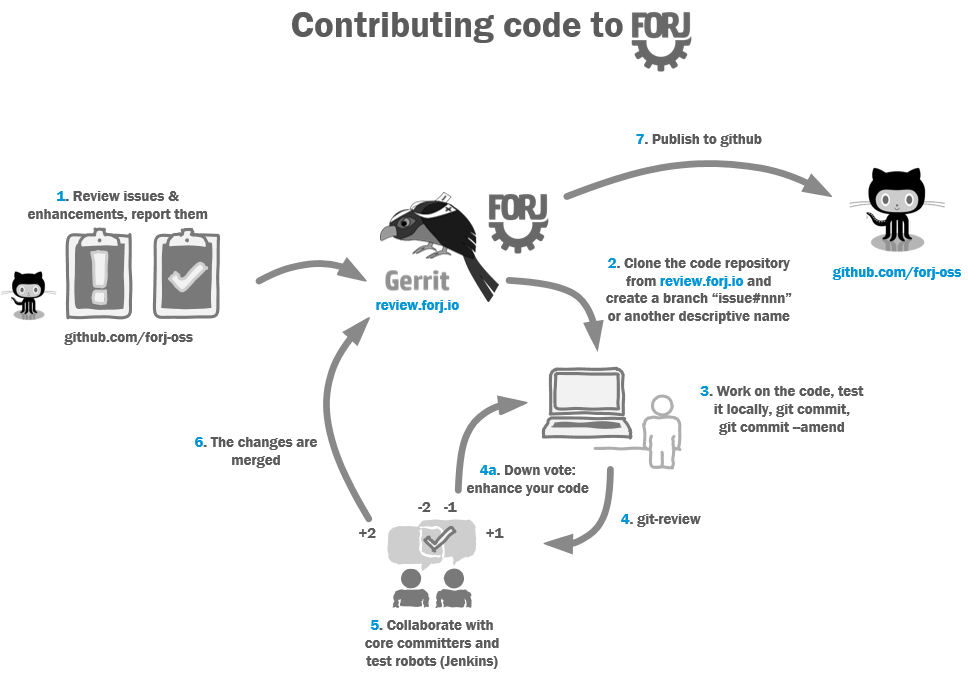
For more information on this process, please refer to Openstack’s Gerrit workflow.
Useful links:
2.3.3. Contributing documentation
Documentation is also an open source project. The sources are available from the main Forj repository on Github. We encourage you to make improvements, whether big or small, to this documentation.
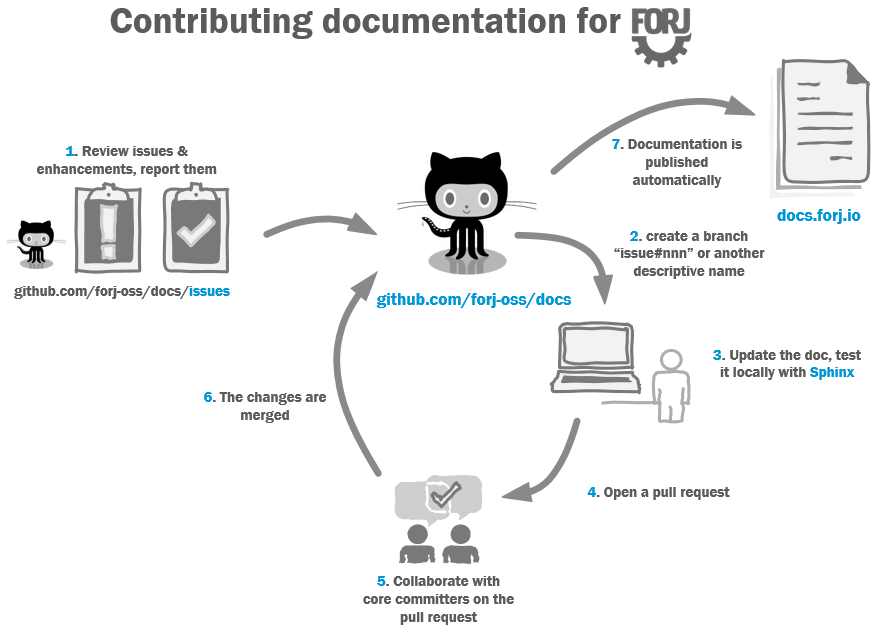
Useful links:
- Forj’s documentation repository
- Sphinx document generator
Forj’s user and admin documentation (http://docs.forj.io/) is hosted on “readthedocs.org” (http://read-the-docs.readthedocs.org/) at this address: https://readthedocs.org/projects/forj/ The documentation uses “RST” markup language and is generated with Sphinx http://sphinx-doc.org/
To contribute to the documentation
- Fork the docs repository from github: http://github.com/forj-oss/docs
- Setup your sphinx environment on your PC: http://sphinx-doc.org/
- Edit the doc
- test it with “make html”
- Open a pull request on github and interact with the core team
- Once reviewed, the changes are merged by the core team in the Github repository
- The documentation gets refreshed automatically thanks to a web hook
2.3.4. Criteria before submitting a contribution
- Contributor has verified that their changes do not break any of the builds
- Contributor has provided or updated unit tests, if there is an existing unit test structure for any of the components affected
- If there is no unit test structure, the contributor has thoroughly tested their changes manually, and can describe the results
- Code is in the style of the code that surrounds it
2.3.5. During Review the Maintainer Will
- Look to see that your have the DCO on file and added the necessary Apache v2.0 license headers to the files (automated)
- If you are someone entirely new to the Project, they may get in touch with you via the contact information you have provided
- If there are anomalies such as inconsistent name or email address between signoffs, they may ask you to clarify
- This process may take some time, since we may conduct testing, and there may be concurrent activity which must be checked for merge conflicts, architectural issues, etc.
2.3.6. After the merge
- Your commits will be merged onto the master branch
- The maintainer’s identity who accepted your pull request will be recorded in the merge
- Congrats, you are now a Forj contributor!
2.3.7. Community guidelines
We want to keep the Forj Community an interactive, open place to participate, but we need your help. We expect participants across all areas of the website - including the mailing list, forum, bug tracker - will:
- Be courteous and polite to fellow community members
- Respect other people: no racial, gender or other abuse will be tolerated
- Not swear
- Ensure that you have legal rights for posting your content and are not violating any copyright, trade secrets, trademark or other proprietary rights.
- Make sure your posts are sent to the appropriate channels and are relevant to the discussion. You can visit the mailing list page to determine the right place to post your question or discussion topic.